Radios
Choose a portable rig for park activations
Learn about handheld, mobile, and HF transceivers that are easy to carry and reliable outdoors.
(tr)uSDX
 "The golden rule of radio: Only use enough power to complete the communication."
Basics
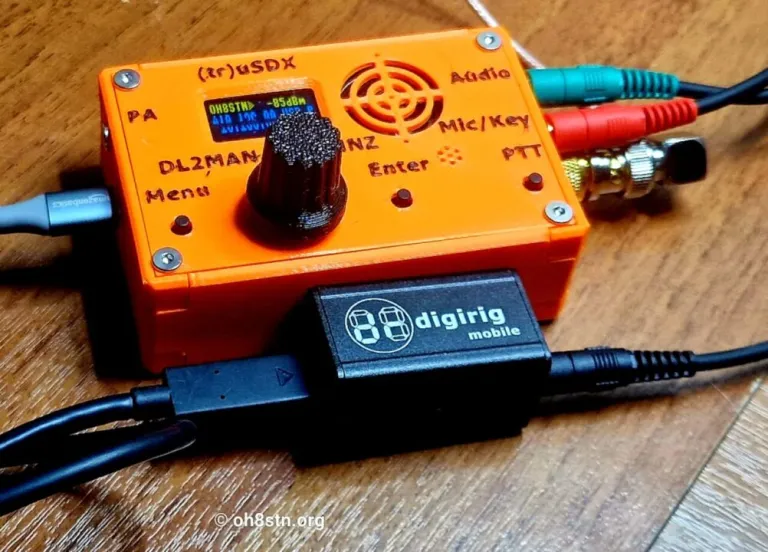
The (tr)uSDX is a compact, low-power QRP transceiver. It operates on HF bands (7-30 MHz) with power levels ranging from 0.5W to 7W, depending on the power source and configuration. It supports various modes including CW, SSB, AM, FM, and digital modes like FT8 and WSPR with recent firmware updates enabling direct USB audio for digital operation without needing a separate soundcard interface.- Power: The radio operates on 5V USB (limiting TX power to ~0.5W) or 12V DC
(delivering 2-7W depending on the band).
Current consumption is very low at about ~80mA on RX, and 500mA on TX @13.8V with a PA efficiency of ~85%. A 3x18650 battery pack is a common portable power solution. The (tr)uSDX features a highly efficient Class-E power amplifier. Its power output scales directly with the input voltage, peaking at around 5 watts under ideal conditions (e.g. 13.8V).- 13.8V: 5 watts output
- 12V: 4 to 4.5 watts output
- 9V - 10V: 2 to 3 watts output
- 5V (USB): 0.5to 1 watt output
- Antenna: A random wire with a 9:1 balun or an End-Fed Half-Wave (EFHW) antenna is recommended for flexibility. An EFHW cut for 40m works well for 40, 20, 15, and 10 meters without a tuner.
- CW Operation: If using Morse code, a dedicated paddle is recommended over the built-in key button for better control. The radio includes a built-in CW decoder to assist with reception.
Range(FM voice)
Range varies widely based on conditions, but typical expectations are:- Local (0-5 miles): Reliable communication with 0.5W and a simple random wire antenna, especially on lower bands (40m/20m).
- Regional (5-50 miles): Achievable with 2-7W and a well-tuned EFHW antenna, particularly on 20m during favorable conditions.
- DX (50+ miles): Possible under optimal conditions (e.g., low noise, good propagation) with 7W and a high-quality antenna, but not guaranteed.
Overall, the (tr)uSDX is best suited for local use and regional communication, with DX contacts being more of a challenge that depends heavily on conditions and antenna setup.
Digital Modes
With recent firmware updates, the (tr)uSDX can transmit and receive digital modes like FT8 and WSPR directly over USB without needing a separate soundcard interface.This makes it a versatile option for digital mode operation in a compact, portable package. To use digital modes, simply connect the radio to your computer via USB, select the appropriate audio input/output in your digital mode software (e.g., WSJT-X), and ensure the radio is configured for CAT control to allow for frequency and mode changes from the software interface.
(tr)uSDX's direct USB audio capability simplifies digital mode operation, making it an excellent choice for portable digital communications without the need for additional hardware interfaces.
1000 miles per watt
The (tr)uSDX can achieve impressive range for its power level, with reports of 1000 miles per watt under optimal conditions. This is due to its efficient design, low noise floor, and the ability to use high-performance antennas like EFHWs. While actual range will vary based on many factors, the (tr)uSDX's efficiency allows for surprisingly long-distance communication even at low power levels, making it a popular choice for QRP enthusiasts and portable operations.Handheld radios
Great for local park nets, simplex contacts, and compact setup.
Mobile/portable rigs
Balance performance and portability with small mobile radio options.
HF QRP
Ideal for long-distance contacts while keeping weight and power use low.